Wednesday, October 10, 2012

If walls could talk...

"The Mexican muralists produced the greatest public revolutionary art of this century, and their influence throughout Latin America - most recently in the wall paintings in Nicaragua - has been far-reaching and continuous.  There was a time, during the 1930s, when it was also felt in Britain, and in the USA, but since then they have rarely entered artistic discourse."
(Dawn Ades, Art in Latin America, 151)


Murals are cool.  They make places more interesting.  People have been painting on walls for a long time.  Some murals are considered great works of art.  Sometimes they serve political purposes; sometimes they’re just to look pretty.  I’d guess that most times they are commissioned works of art.  Mexican murals turned out to be a big hit – they served a distinct purpose at a time of political and social change.  The purposes murals serve are highly varied, and I’d argue that there’s always an underlying motive for creating them.

downtown Provo

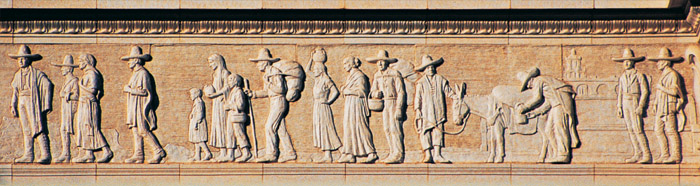
You don’t have to go to Mexico to see murals – we’ve got some here in Provo, even on campus.  I think that relief sculptures can also count as a type of mural (carved, rather than painted).  There are plenty of those around too.

relief sculpture on the LDS Mesa Arizona Temple (source)

Murals are a unique form of visual art because they’re stationary.  I think this adds to the artistic experience - in order to see a mural in person, one must travel to its location.  This forces the observer to also experience the sounds, smells, and general ambiance of the mural’s location.  But I think in most cases, people don’t travel to a place specifically to view its murals; the murals add to the general ambiance of the place.


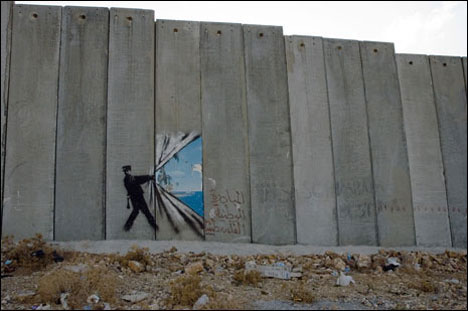
What about painted walls that aren't commissioned works of art?  Most people call it graffiti.  It often serves the same purpose – to send a message to the masses in a public place.  I didn't think much about graffiti until I heard about Banksy, an anonymous street artist from England.  If you haven’t heard of him, you should definitely read up on him – he’s a super-interesting figure.  He definitely has a political/social agenda, but I think he does much of his work for his own enjoyment (and to make places more interesting).  Reading through one of his books completely changed my attitude toward graffiti.  What do you think – is graffiti a legitimate form of art?  See what he has to say about it:

“Graffiti is not the lowest form of art.  Despite having to creep about at night and lie to your mum it’s actually the most honest artform available.  There is no elitism or hype, it exhibits on some of the best walls a town has to offer, and nobody is put off by the price of admission…

They say graffiti frightens people and is symbolic of the decline in society...

The people who truly deface our neighbourhoods are the companies that scrawl their giant slogans across buildings and buses trying to make us feel inadequate unless we but their stuff.  They expect to be able to shout their message in your face from every available surface but you’re never allowed to answer back.  Well, they started this fight and the wall is the weapon of choice to hit them back.

Some people become cops because they want to make the world a better place.  Some people become vandals because they want to make the world a better looking place.”

(Banksy, Wall and Piece, 8)
Wednesday, October 3, 2012

Science

"The life and death of hypotheses.  From the equation - me as part of the Cosmos - to the axiom - the Cosmos as part of me.  Subsistence.  Knowledge.  Anthropophagy."
(Anthropophagite Manifesto, Revista de Antropofagia, (São Paulo), no. 1, May 1928)

I didn't know what to make of this manifesto when I read it.  I still don't.  But the quote above immediately reminded me of the following:


That dialogue was taken from an interview of Neil deGrasse Tyson, perhaps the most well-known astrophysicist of this generation.  (He even came and spoke at a forum at BYU a few years back.)  The interviewer asks him to share the most astounding fact about the universe.  Tyson responds by explaining how our bodies are made up of atoms that were formed from the supernovae of stars, and then says:

“…when I look up at the night sky… I know that yes, we are part of this universe, we are in this universe, but perhaps more important than both of those facts is that the universe is in us.  When I reflect on that fact… I feel big, because my atoms came from those stars.  There’s a level of connectivity… You want to feel relevant; you want to feel like you’re a participant in the goings-on of activities and events around you.  That’s precisely what we are just by being alive.”

What a humanities quote from a scientist, right?!?!  I'm a science major, but I still think that humanities are important and that the two fields of study have much to learn from each other.  The manifesto talks about “the Cosmos as part of me,” which is literally true.  The tone of this video clip may not match the tone of the manifesto, but I think anthropophagy relates to both.  We consume subsistence, knowledge, and the world around us.  We take in the universe because we want to be a part of it and we want it to be a part of us.  There’s something very natural and very human about being curious about the world around us; we explore and do experiments to learn more about it.  From a certain point of view, in this process the universe is trying to understand itself.
The works of God continue,
And worlds and lives abound;
Improvement and progression
Have one eternal round.
There is no end to matter;
There is no end to space;
There is no end to spirit;
There is no end to race.

-W.W. Phelps

Wednesday, September 26, 2012

Good ol' Iracema

"The white warrior no longer desires any other country save the land of his son and of his heart."
(José de Alencar, Iracema, 79)

Iracema's going pretty well, I guess.  The story's interesting enough, but I'm still trying to get over the style of writing.  I connect more with the overall arc and context of the story, so it was hard to find a single quote to write about.  We've talked often about movies whose plots parallel the story of Iracema (Dances with Wolves, Pocahontas, Avatar).  In class the other day, I thought of one that we haven't discussed:  The Last Samurai.

To sum up the story (spoiler alert), Nathan Algren (Tom Cruise) is a former U.S. Civil War captain hired by the quickly modernizing (o sea Westernizing) Japan to lead their army against a rebellious group of Samurai who want to preserve the traditional ways of their culture.  During a battle, he is taken prisoner by the "savage" Samurai and lives with them for several months:


As you can probably guess, he ends up finding inner peace while learning their ways, falling in love, and becoming one of them.  

One of the most interesting differences (compared to Iracema) is that the main character is the Westerner.  Further, instead of joining the natives willingly, he's captured by them.  But the lessons he learns about himself, the people, and life change his attitude toward them.  Eventually, he's given his own katana.  To me, this is comparable to when Martim receives a native name and gets war-painted.  The white warrior abandons his previous life to start a new one in "the land of... his heart."

Iracema is Alencar's way of defining Brazil's national identity - an origin story.  In The Last Samurai, the story is not about origins but the preservation of a national identity.  Katsumoto, the head Samurai, leads a rebellion against the emperor's armies to maintain Japanese legacy and traditions.  At the same time, he's deeply loyal to the emperor (his former student) as the leader of Japan.  Unfortunately, the emperor doesn't understand Katsumoto's motives until it's too late:


I think an important point to consider is the cost (on both sides) of the "Westerner" joining the "natives," oftentimes discovering a personal identity.  Nathan Algren will never be with his people again, and Martim and Iracema's lives will be changed forever.  Obviously they all have a choice, and the life they choose is probably better than the previous one.  But different cultures coming into contact with each other is often messy.